
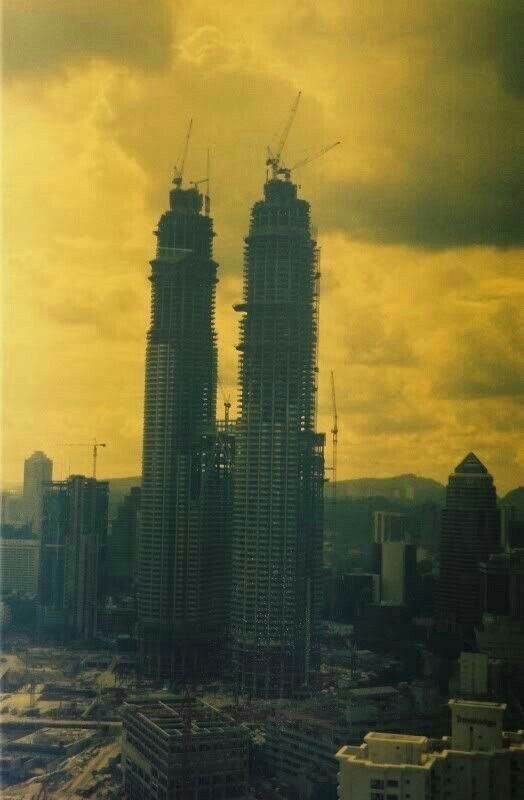
Prerequisites: Development of Kuala Lumpur
By the late 1980s, Kuala Lumpur had transformed from a small mining town into a bustling metropolis, serving as the economic and political heart of Malaysia. The city's rapid growth was fueled by the nation's expanding economy, particularly in manufacturing, finance, and the oil and gas sector. As Malaysia positioned itself as a key player in Southeast Asia's economic development, the need for a symbol that would reflect this newfound prosperity became increasingly apparent.
The Malaysian capital was experiencing unprecedented urban development, with new commercial districts emerging and the skyline evolving rapidly. However, the city lacked a defining architectural landmark that could represent Malaysia's ambitions on the world stage. The government, under the leadership of Prime Minister Dr. Mahathir Mohamad, recognized that a world-class architectural project could serve multiple purposes: it would demonstrate Malaysia's technical capabilities, attract international attention, boost tourism, and create a source of national pride.
Petronas, Malaysia's national oil and gas company, had become one of the country's most successful enterprises, generating substantial revenue that could fund such an ambitious project. The company's leadership, particularly Tan Sri Azizan Zainul Abidin, saw an opportunity to create a headquarters that would not only serve as a corporate symbol but also contribute to the nation's architectural legacy. The decision to build twin towers was strategic—it would create a more dramatic visual impact and allow for greater flexibility in space allocation.
The Idea of Creating the World's Tallest Towers
The concept of building the world's tallest buildings was audacious and ambitious. In the early 1990s, the title of world's tallest building was held by the Sears Tower (now Willis Tower) in Chicago, standing at 442 meters. The idea of surpassing this record was not just about height—it was about making a statement that Malaysia had arrived as a modern, technologically advanced nation capable of competing with the world's leading economies.
This vision aligned perfectly with Dr. Mahathir Mohamad's Vision 2020, a comprehensive plan to transform Malaysia into a fully developed nation by the year 2020. The towers would serve as a physical manifestation of this vision, demonstrating that Malaysia could not only match but exceed the achievements of more established nations. The project was seen as a catalyst for further development, inspiring confidence in Malaysia's future and attracting international investment.
The decision to build twin towers rather than a single structure was both practical and symbolic. From a practical standpoint, twin towers would provide more office space and create a more balanced architectural composition. Symbolically, the twin towers could represent the dual nature of Malaysia's identity—the balance between tradition and modernity, between Islamic values and global engagement, between local culture and international aspirations.
International Competition of Architects
To ensure the highest quality of design, Petronas organized an international architectural competition that attracted submissions from some of the world's most renowned architectural firms. This competition was not merely a formality—it was a genuine search for a design that would capture Malaysia's spirit while meeting the technical requirements of creating a world-class skyscraper.
Numerous prestigious firms participated, each bringing their unique vision and expertise. The competition criteria were comprehensive, requiring not just aesthetic excellence but also consideration of Malaysia's cultural heritage, environmental sustainability, structural innovation, and functional efficiency. The winning design would need to balance these multiple requirements while creating a structure that would stand as an icon for generations.
The evaluation process was rigorous, involving panels of experts in architecture, engineering, urban planning, and cultural studies. Each submission was carefully analyzed for its architectural merit, technical feasibility, cultural sensitivity, and potential to become a symbol of national pride. The competition represented Malaysia's commitment to excellence and its willingness to engage with the global architectural community.
Selection of Style: Postmodernism + Islamic Motifs
The winning design by César Pelli brilliantly combined postmodern architectural principles with traditional Islamic geometric patterns. This fusion was not accidental—it represented a deliberate choice to create a building that would honor Malaysia's Islamic heritage while embracing contemporary design language. The postmodern approach allowed for the incorporation of historical references and cultural symbols without resorting to literal imitation of traditional architecture.
The Islamic geometric patterns, particularly the eight-pointed star (rub el hizb), became a central element of the design. This pattern, which appears in the floor plan of the towers, creates a distinctive silhouette that is both modern and deeply rooted in Islamic art and architecture. The geometric complexity of the plan not only provides aesthetic interest but also serves structural purposes, creating a more stable and efficient building form.
The postmodern style allowed the architects to break free from the rigid functionalism of earlier skyscraper designs while avoiding the excesses of pure decoration. The result was a building that felt both timeless and contemporary, both Malaysian and universal. This stylistic choice reflected Malaysia's position as a nation that could successfully blend its traditional values with modern aspirations, creating something entirely new in the process.
The selection of this particular design approach demonstrated Malaysia's confidence in its cultural identity. Rather than simply copying Western architectural styles or retreating into traditionalism, the country chose a path that celebrated both its heritage and its future. This decision would prove to be prescient, as the towers became not just buildings but symbols of a nation comfortable with its place in the modern world while remaining true to its cultural roots.