
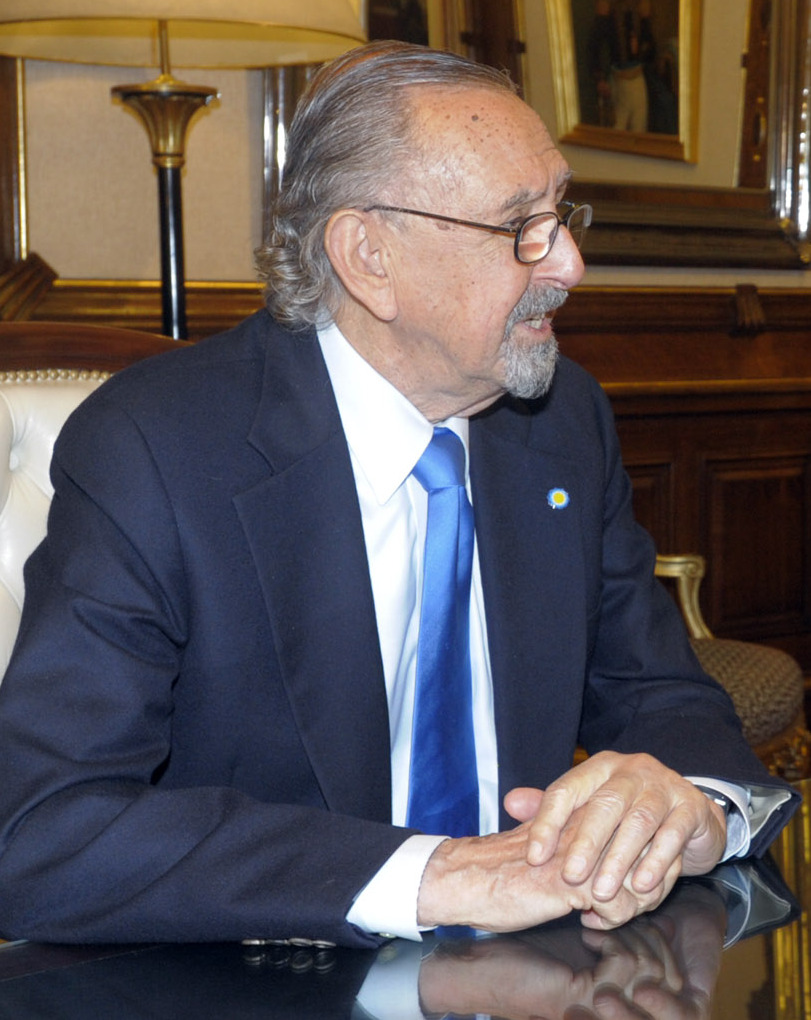
Early Life and Education
César Pelli was born on October 12, 1926, in San Miguel de Tucumán, Argentina. His early exposure to architecture came through his father, who worked in construction, sparking Pelli's lifelong passion for building and design. After completing his secondary education, Pelli enrolled at the Universidad Nacional de Tucumán, where he studied architecture and graduated in 1949. His exceptional talent and dedication to the field were evident from his earliest academic work.
Following his graduation, Pelli moved to the United States to pursue advanced studies, recognizing that the American architectural scene offered opportunities for innovation and growth that were not yet available in Argentina. He enrolled at the University of Illinois at Urbana-Champaign, where he earned his Master of Architecture degree in 1954. This period of study exposed him to the latest developments in architectural theory and practice, shaping his approach to design for the rest of his career.
Pelli's education provided him with a solid foundation in both the technical and artistic aspects of architecture. He learned to balance aesthetic considerations with practical requirements, a skill that would serve him well throughout his career. His studies also introduced him to the work of modernist masters, whose influence would be visible in his own designs, though he would develop a distinctive style that was uniquely his own.
Career and Architectural Philosophy
After completing his education, Pelli began his professional career working for Eero Saarinen, one of the most influential architects of the mid-20th century. This experience proved formative, as Saarinen's approach to architecture emphasized both functional excellence and aesthetic innovation. Pelli worked on several significant projects during this period, including the TWA Flight Center at JFK Airport and the Gateway Arch in St. Louis, gaining invaluable experience in large-scale architectural design.
In 1977, Pelli established his own architectural firm, which would later become Pelli Clarke Pelli Architects. The firm quickly gained recognition for its innovative approach to high-rise design and its ability to create buildings that were both visually striking and highly functional. Pelli's architectural philosophy emphasized the importance of creating buildings that enhanced their urban context while serving their practical purposes effectively.
Throughout his career, Pelli maintained that architecture should reflect the culture and aspirations of the people it serves. He believed that great buildings should be both beautiful and meaningful, structures that contribute positively to their communities while expressing the values and identity of their occupants. This philosophy would guide his approach to the Petronas Twin Towers project, where he sought to create a building that honored Malaysia's cultural heritage while expressing a forward-looking vision.
Previous Notable Projects
Before designing the Petronas Twin Towers, Pelli had already established himself as one of the world's leading architects through his work on numerous high-profile projects. Among his most significant early works was the Pacific Design Center in Los Angeles, completed in 1975. This project demonstrated Pelli's ability to create buildings that were both functional and visually striking, earning him recognition within the architectural community.
Another notable project was the World Financial Center in New York City, completed in the 1980s. This complex of four office towers demonstrated Pelli's expertise in large-scale commercial development and his ability to create buildings that worked together as a cohesive whole. The project's success further established his reputation as an architect capable of handling the most complex and demanding projects.
Pelli's work on the Canary Wharf Tower in London, completed in 1991, showcased his ability to adapt his design approach to different cultural contexts while maintaining his distinctive architectural voice. These and other projects demonstrated his versatility and his ability to create buildings that were appropriate to their specific contexts while expressing universal principles of good design.
The Petronas Twin Towers Project
The Petronas Twin Towers project represented the culmination of Pelli's career and the realization of many of his architectural ideals. When the international competition was announced, Pelli recognized this as an opportunity to create a building that would be both a technical achievement and a cultural statement. His winning design successfully balanced these multiple objectives, creating a structure that has become one of the world's most recognized architectural landmarks.
Pelli's approach to the project was characterized by his deep respect for Malaysian culture and his commitment to creating a building that would honor local traditions while embracing modern design principles. He spent considerable time studying Islamic art and architecture, traditional Malaysian building forms, and the cultural significance of geometric patterns in Islamic design. This research informed his decision to incorporate the eight-pointed star pattern into the towers' floor plan, creating a design that was both innovative and culturally sensitive.
Throughout the design and construction process, Pelli maintained a hands-on approach, personally overseeing critical design decisions and ensuring that the final product matched his original vision. His commitment to excellence and attention to detail helped ensure that the towers would become not just functional office buildings but true architectural landmarks. The success of the Petronas Twin Towers project cemented Pelli's reputation as one of the greatest architects of his generation and demonstrated the power of architecture to express cultural identity while achieving technical excellence.
Legacy and Impact
César Pelli's work on the Petronas Twin Towers has had a lasting impact on both architecture and urban design. The towers demonstrated that it was possible to create buildings that were both culturally sensitive and internationally recognized, structures that honored local traditions while achieving global significance. This approach has influenced numerous subsequent projects around the world, inspiring architects to consider cultural context more carefully in their designs.
Pelli's career spanned more than six decades, during which he designed over 50 major projects worldwide. His work earned him numerous awards and honors, including the American Institute of Architects Gold Medal, one of the profession's highest honors. He was also recognized internationally, receiving awards and recognition from architectural organizations around the world.
The Petronas Twin Towers remain Pelli's most famous work, a testament to his ability to create buildings that capture the public imagination while serving their practical purposes. The towers' success demonstrates the power of architectural vision when combined with technical expertise, cultural sensitivity, and collaborative teamwork. César Pelli passed away in 2019, but his architectural legacy continues to inspire architects and delight the public through the many buildings he designed throughout his remarkable career.